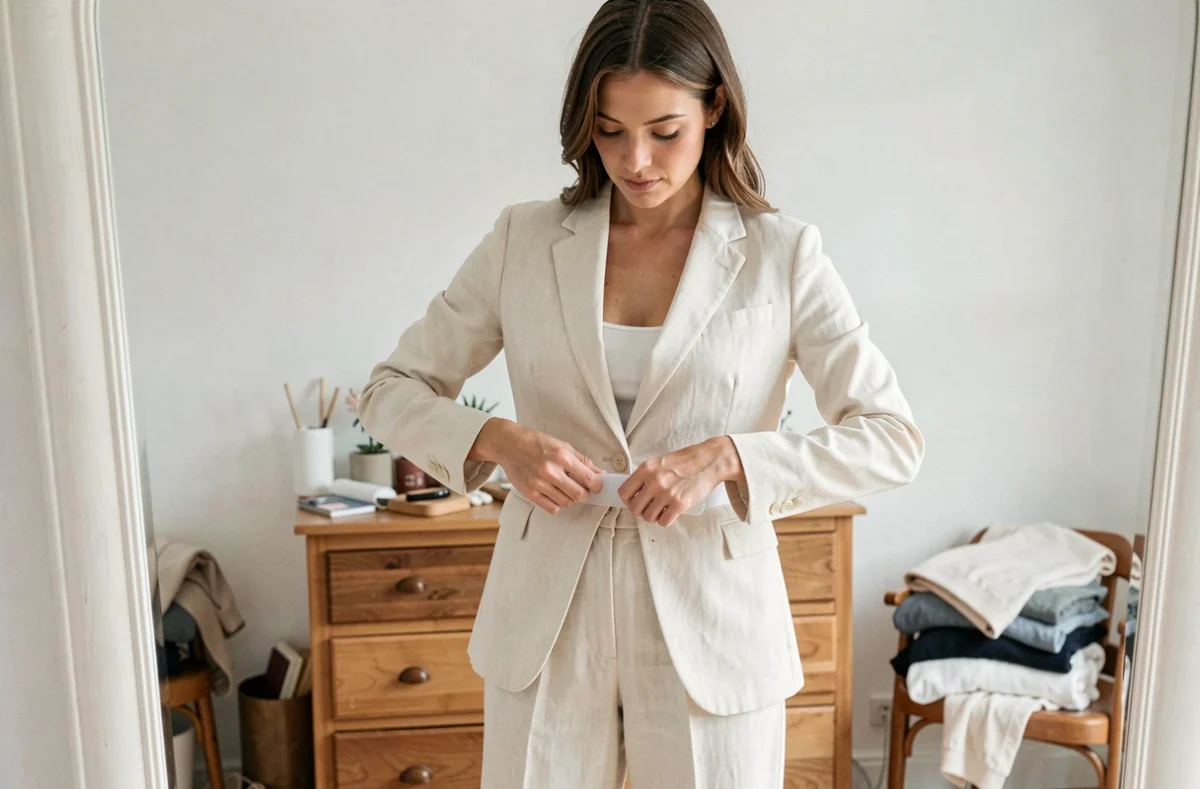
A suit pant without belt loops, a wrap skirt, a fitted jumpsuit: as soon as you put a belt on a garment that wasn’t designed for it, the realization comes quickly. The belt twists, rides up, or slides down to the hips with every movement. Several solutions exist to keep a belt in place without loops, but not all are equal depending on the fabric and cut of the garment.
Side tightening straps and internal elastic: when the pant goes without a belt
Before trying to secure a belt on a garment without loops, one might wonder if the garment actually needs a belt. So-called beltless pants often incorporate their own adjustment systems.
Side tightening straps allow you to cinch the waist without an external accessory. They can be found on some chinos, dress pants, and vintage styles. An integrated drawstring or an elastic sewn into the waistband of the pants serves the same purpose.
These alternatives avoid a recurring problem: the pressure of a traditional belt on a fabric not reinforced by loops. Without a guide, the leather or fabric of the belt presses directly against the material, which can distort the waist of the garment over time.
If the pants already have a tightening system, using it remains the cleanest solution. For cases where you still want to keep a belt without loops, you need to turn to dedicated fastening methods.
Internal belt without buckle: the invisible solution under a shirt
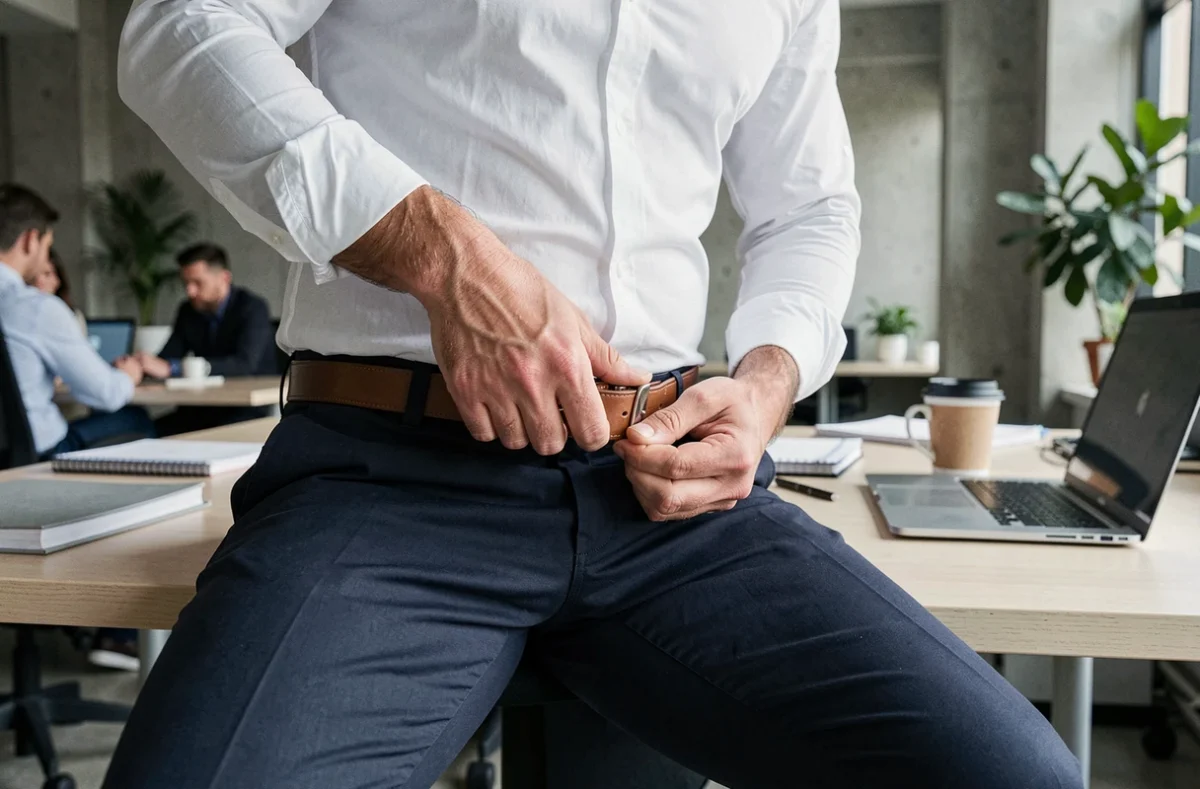
The internal belt is worn under the garment or inside the pants, against the fabric. It generally consists of a stretch band equipped with a non-slip surface (silicone or rubber) that adheres to both the pants and the skin or underwear.
It is not visible under a tucked-in shirt, making it suitable for formal outfits. It adds no bulk to the waist, unlike a traditional belt that creates a bulge under thin fabric.
Choosing the right width of elastic band
A band that is too narrow (less than two centimeters) tends to roll up on itself throughout the day. A band of three to four centimeters distributes pressure better and stays in place longer, especially when sitting.
Feedback varies on this point: some users find that the elastic loses its grip after several washes, while others observe no degradation over several months. The determining factor seems to be the quality of the non-slip coating rather than the elastic itself.
Clips, pins, and fabric adhesive: securing a traditional belt without loops
When you want to wear a visible belt for aesthetic reasons, it needs to be mechanically stabilized on the garment. Three types of fasteners work, each with its limitations.
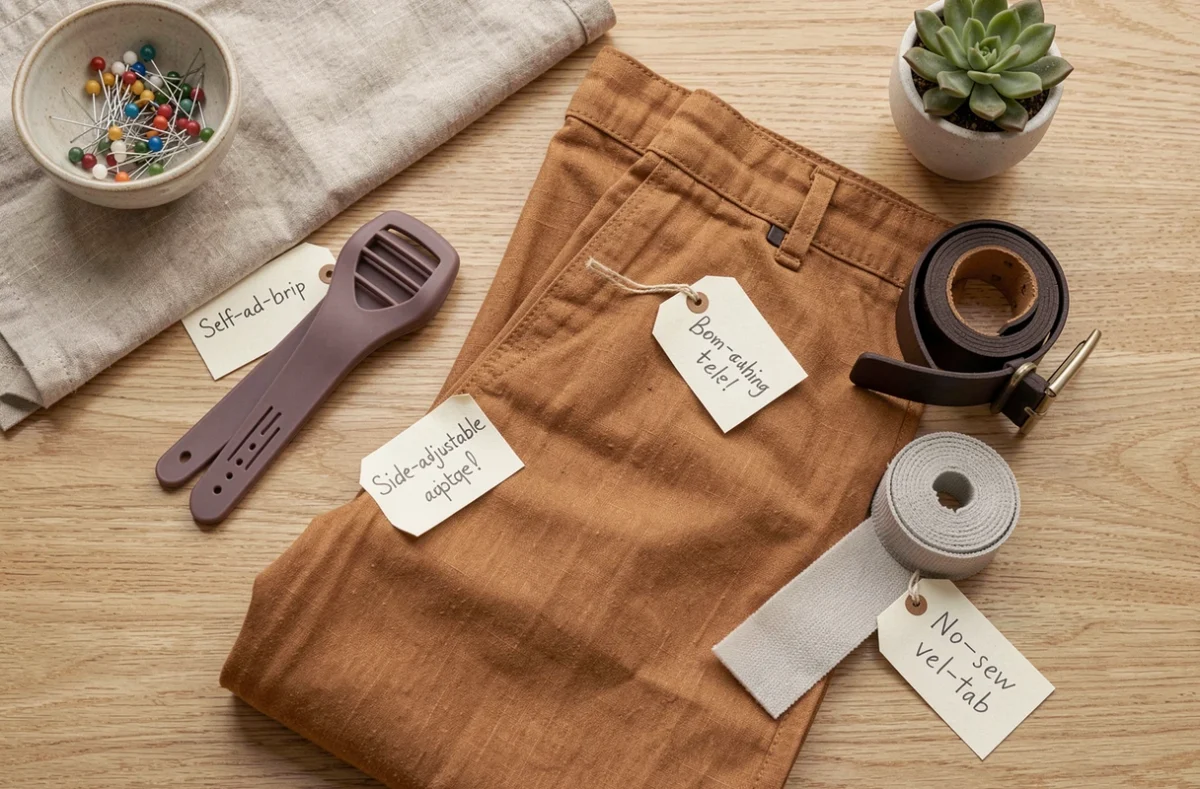
- Belt clips attach to the top edge of the pants and pinch the belt on top. They replace the loop by creating a discreet anchor point. Two clips are sufficient (one on each side of the hips) to prevent rotation.
- Safety pins, placed inside, pass through the fabric of the belt and that of the pants to secure them together. This method is reliable but leaves micro-perforations in delicate fabrics.
- Double-sided fabric tape sticks the belt directly to the garment. It works well on thick cotton or denim, much less on silk or satin where it can leave marks.
Precautions with adhesive on delicate fabrics
Before applying fabric tape, always test on a hidden area (inside the waistband of the pants, hem). Sweat reduces adhesion over the hours, making this method less reliable for a full day of work. On lightweight synthetic materials, a prior skin test avoids irritation if the tape comes into contact with the skin.
Thin suspenders as an alternative to the belt on pants without loops
We don’t always think about it, but suspenders eliminate the problem at its root. They hold up the pants from the shoulders, with no contact with the waist.
Suspenders distribute tension across the shoulders and prevent the pants from slipping down even in prolonged sitting positions. For office days or long periods of standing, they offer more consistent support than a belt placed on fabric without loops.
Clip-on or button suspenders
Clip-on models attach directly to the waistband of the pants. No sewing required, no need for pre-sewn buttons. Button models require a small modification to the pants (sewing six buttons inside the waistband) but hold more securely and do not damage the fabric.
For a cohesive look, avoid combining suspenders and a visible belt. Both serve the same function, and layering them creates a cluttered waistline.
Knotted technique for soft fabric or rope belts
On a dress, jumpsuit, or wide pants, a soft belt tied at the waist can hold without loops if the knot is well executed. The principle: create enough friction for the belt not to slip.
The flat knot (two crossed loops) remains the most stable. A simple knot slips as soon as the fabric of the belt is satin or smooth. On a rope or thick canvas belt, the rough texture acts as a natural brake.
For soft leather belts, knotting works less well: leather retains the memory of its shape, and the knot tends to come undone after a few hours. In this case, a discreet clip in addition to the knot solves the problem.
The choice of method primarily depends on the garment. A structured wool pant holds up well with clips or an internal belt. A fluid viscose skirt calls for knotting or fabric adhesive instead. Testing the fastening before going out (a few bends, sitting position, brisk walking) remains the only reliable way to check that the belt will hold all day long.