
Choosing a plunge saw involves balancing several technical parameters that do not all carry the same weight depending on the type of work intended. Cutting depth, compatibility of the guide rail, corded or battery-powered motorization: each criterion measurably affects precision and user comfort. This article compares the key data to prioritize in order to identify the model suited for your cuts.
Compatibility of guide rails between plunge saw brands
Classic buying guides mention the existence of a rail without detailing a point that regularly causes problems: not all rails are interchangeable from one brand to another. The groove of the saw’s base and the profile of the rail must match to the millimeter, or else lateral play will reduce cutting precision.
Some manufacturers use a proprietary rail profile. Others adopt a more common standard compatible with several brands. Before purchasing, checking if the rail supplied with the saw can be replaced by a longer model from another manufacturer helps avoid being trapped in a closed ecosystem.
To delve deeper into the criteria for choosing a plunge saw, the question of the rail deserves as much attention as that of motor power. A good length rail, rigid and compatible with your machine, directly conditions the straightness of long cuts on panels.
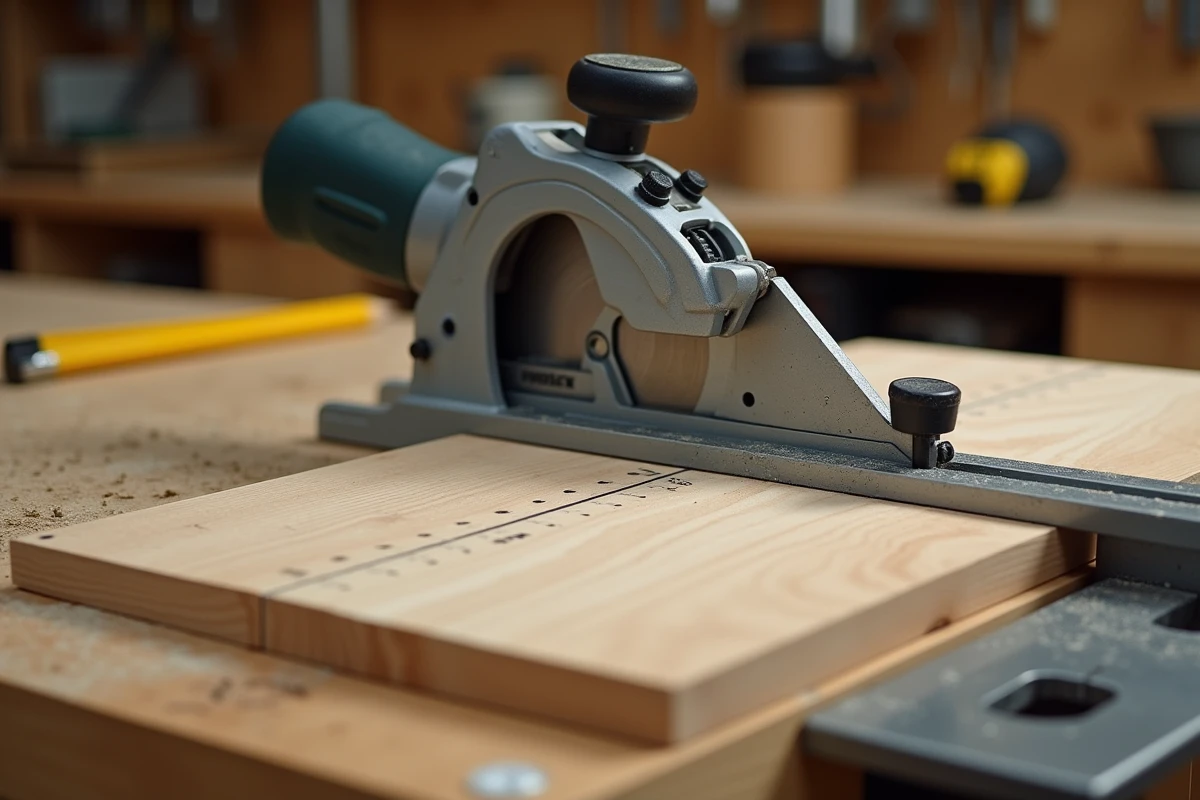
Corded or cordless plunge saw: a comparison of technical trade-offs
High-density battery platforms (18 V, or even bi-18 V to reach the equivalent of 36 V) are gaining ground over corded models. The table below summarizes the concrete differences between the two motorizations.
| Criterion | Corded | Cordless (high-density battery) |
|---|---|---|
| Constant power | Stable as long as the mains supply is available | Decreases at the end of charge, especially in hard woods |
| Total weight | Lighter (no built-in battery) | Heavier by several hundred grams |
| Mobility on site | Limited by the cable and available outlet | Total, including outdoors without power supply |
| Entry cost | Generally lower for equivalent power | Higher (battery and charger often sold separately) |
| Maintenance | Few constraints | Batteries need to be stored properly, limited lifespan |
For panel cuts in the workshop with a nearby outlet, corded models retain an advantage in terms of power-to-weight ratio. However, for work on site or outdoor decking installation, a cordless model on a 36 V platform offers a freedom of movement that is hard to compensate for with an extension cord.
Cutting depth and blade diameter: what the numbers change in practice
The maximum cutting depth depends on the diameter of the blade mounted on the saw. The most common models accept blades of small, medium, or large diameter, which translates into different cutting capabilities.
- Small diameter blades are suitable for particle boards, thin plywood, and laminates. The machine is compact and lightweight, suitable for indoor woodworking tasks.
- Medium diameter blades cover the majority of domestic and semi-professional uses: countertops, solid wood flooring, medium thickness panels.
- Large diameter blades allow for cutting through thick solid wood boards or multilayer assemblies, but they add weight to the machine and require a more powerful motor.
The choice of blade diameter determines the maximum thickness that the saw can cut through in a single pass. Two passes on a thick material with a small blade degrade precision and leave a visible mark at the junction point.
Tooth design and blade materials
Beyond diameter, the number of teeth and their geometry influence the quality of the cut. A blade with fewer teeth evacuates chips better in soft wood but leaves a coarser surface finish. A fine-toothed blade produces clean cuts on laminates and melamine, at the cost of a slower feed rate.
Tungsten carbide-tipped blades remain the standard for longevity. Some high-end models offer anti-friction coatings that reduce heating during prolonged cuts in hard woods or composite materials.

Safety and electronic braking on recent plunge saws
Safety systems have evolved in recent years. Electronic braking stops the blade within seconds after releasing the trigger, compared to ten seconds or more for an inertia stop on models without this feature.
This point changes daily practice: between cuts, waiting for the blade to come to a complete stop slows down the work pace. With electronic braking, the blade is almost immediately stationary, which also reduces the risk of accidental contact when repositioning the workpiece.
Blade guards have also improved in ergonomics. Recent models incorporate quick-release guards that do not obstruct visibility on the cutting line. A well-designed guard should never require forcing to retract manually.
Integrated dust extraction
A dust extraction connection directly on the blade guard improves visibility of the cutting line and limits inhalation of fine dust, especially when cutting fiber panels. Most models offer a nozzle compatible with standard workshop vacuums, but the diameter of the connection varies by brand.
The plunge saw remains a tool whose value depends as much on its accessories (rail, blade, extraction) as on its motor. Comparing models solely on the advertised power overlooks half the subject: the quality of the rail and the compatibility of accessories weigh as much as the watts in the final result.