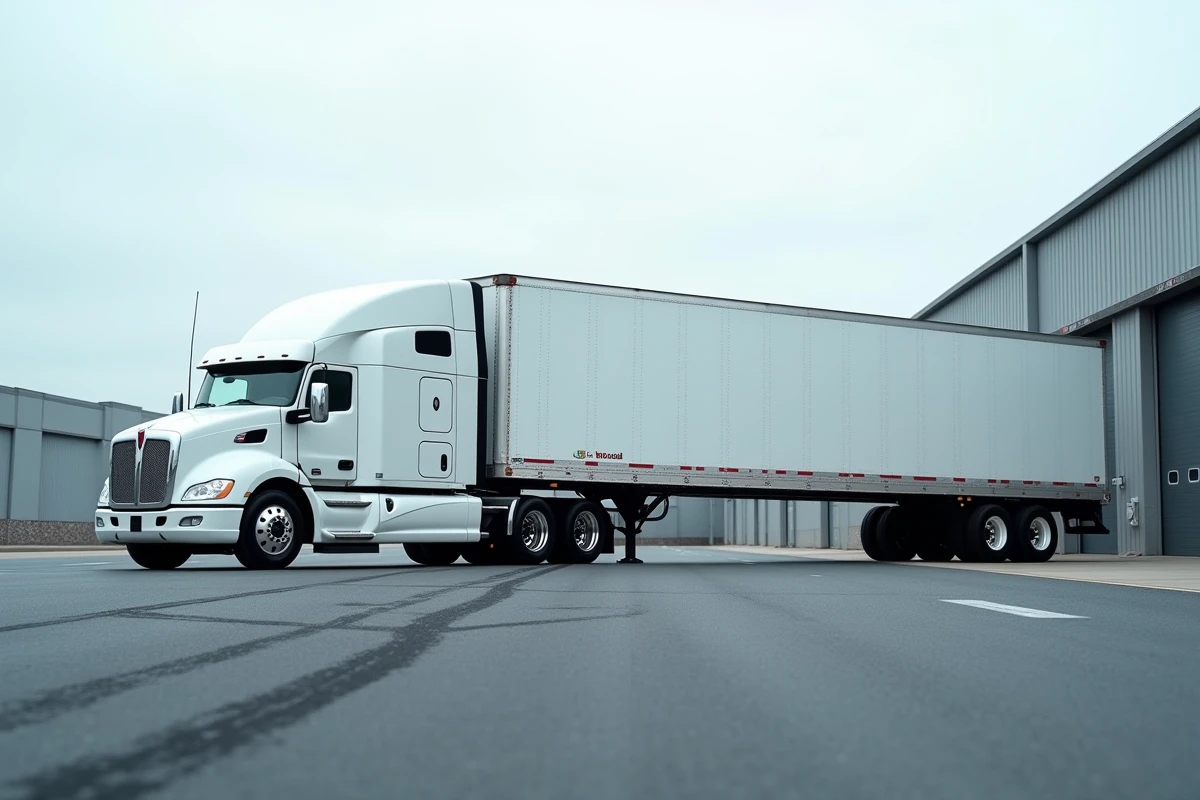
A parked trailer truck on a highway rest area always seems gigantic. Yet, every centimeter of its body responds to specific constraints: road regulations, type of goods, infrastructure used. Understanding these dimensions helps avoid overloads, refusals to pass under a bridge, or fines for exceeding size limits. Here are the concrete benchmarks that matter when preparing a load or choosing a vehicle.
Usable volume and interior dimensions: what matters for loading
Most guides focus on the maximum legal limits. In practice, what determines the success of a transport is the volume that can actually be utilized inside the body.
On a standard van-type semi-trailer, the interior space is always less than the exterior dimensions. The walls, reinforced floor, and roof absorb several centimeters on each side. On a refrigerated model, the thick insulation further reduces the width and height available for pallets.
You may have noticed that the same type of semi-trailer does not always load the same number of pallets? The reason often lies in the interior height. A body with a raised floor (to accommodate lift axles, for example) offers less height under the ceiling. Knowing the dimensions of a standard trailer truck allows you to check this compatibility before loading, not after.
The usable volume depends as much on the thickness of the walls as on the external dimensions. This is a parameter that should always be asked of the carrier or rental company before any booking.

Legal dimensions in France: maximum width, height, and length
In France, the highway code sets clear limits for articulated road vehicles (tractor + semi-trailer).
Maximum allowed width
The maximum width is set at 2.55 meters for a standard semi-trailer. Refrigerated vehicles benefit from an exemption to 2.60 meters. This five-centimeter margin compensates for the additional thickness of thermal insulation.
Note: the transported load counts towards this width. A package that exceeds laterally shifts the entire vehicle into “exceptional transport,” with escort and signaling obligations.
Height: no single national limit, but real constraints
Contrary to popular belief, French regulations do not set an absolute maximum height for heavy goods vehicles in the same way as for width. The commonly accepted limit is around four meters, but it is the infrastructure that imposes the real constraint: bridges, tunnels, toll gantries.
The type of bodywork and roof accessories (deflectors, air conditioners) also modify the total height. A carrier that changes tractors may find themselves with a combination that is several centimeters taller, enough to cause problems under certain structures.
Length of an articulated vehicle
For a tractor coupled to a semi-trailer, the total allowed length does not exceed a value framed by European regulations. The semi-trailer alone typically measures 13.60 meters in length, resulting in a complete combination of around 16.50 meters.
These figures apply to standard configurations. Longer and heavier combinations (sometimes called EuroCombi or Gigaliner) are subject to specific exemptions in some European countries but remain heavily regulated in France.
Total weight and payload: the invisible dimension
The dimensions of a trailer truck are not limited to spatial bulk. The maximum authorized weight determines what you can actually load, regardless of the available volume.
A standard five-axle articulated vehicle is limited in total rolling mass. Once the weight of the empty tractor and trailer is subtracted, the payload remains. The payload varies significantly depending on the type of semi-trailer: a steel dump truck weighs more empty than an aluminum drop-side flatbed, thus leaving less margin for goods.
- A standard van offers a good compromise between volume and payload, suitable for pallets and bulky but light packages.
- A tank or dump truck absorbs a significant part of the weight allowed by its own structure, reducing the transportable load.
- A lowbed trailer accepts tall or heavy pieces, but its usable length is often reduced by access ramps.
- A refrigerated trailer loses both interior volume (insulation) and payload (weight of the cooling unit).
Before choosing, ask yourself: is it the volume or the weight that limits your transport? The answer points towards a specific type of trailer.
Compatibility between dimensions and route: an underestimated parameter
Even with a perfectly compliant combination, some routes pose problems. Local size restrictions (low bridges, narrow streets in city centers, tight roundabouts) do not always appear on consumer GPS devices.
A vehicle compliant with legal dimensions may be prohibited on a specific section. Prefectural or municipal decrees regularly impose height or weight limits lower than national maximums, particularly near urban areas or on older structures.
The current trend in the road transport sector no longer solely focuses on the maximum authorized dimensions. It is shifting towards compatibility between the chosen dimensions, actual payload, and planned route. A slightly shorter or lighter combination can sometimes deliver faster, simply because it can access areas prohibited to standard dimensions.
Mandatory equipment is also evolving. Recent requirements for lateral lighting on high closed trailers slightly modify the actual bulk of the vehicle. Every added accessory eats up a few centimeters of the available dimensions.
Choosing the right dimensions for a trailer truck involves crossing three parameters for each mission: the necessary interior volume, the weight of the goods, and the physical constraints of the route. A carrier who masters these three data points avoids most road blockages.